Forming Processes of Stamped Parts
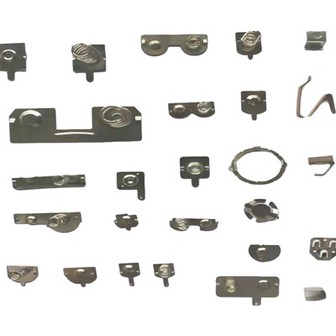
Bending: A plastic forming method that bends metal sheets, tubes, and profiles into specific angles, curvatures, and shapes. Bending is one of the main processes widely used in stamped parts production. The bending of metal materials is essentially an elasto-plastic deformation process. After unloading, the workpiece undergoes elastic recovery deformation in a specific direction, known as springback. Springback affects the workpiece's accuracy and is a critical technical factor that must be considered in the bending process.
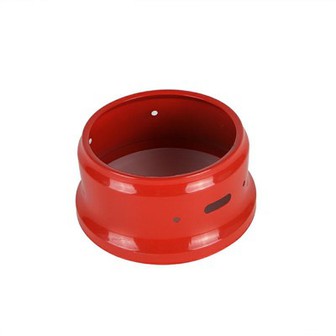
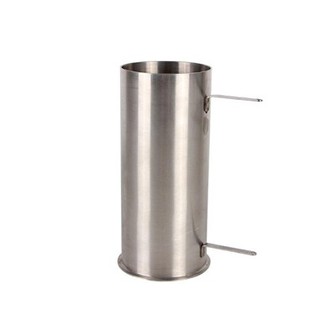
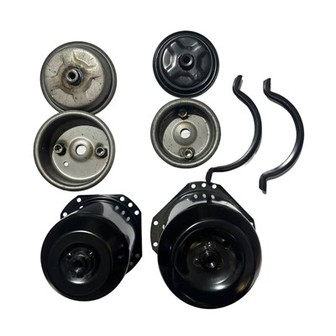
Deep Drawing: Also known as drawing or rolling, deep drawing is a stamping process that uses dies to transform a blank sheet obtained after punching into an open, hollow part. Deep drawing can produce thin-walled parts with cylindrical, stepped, conical, spherical, box-shaped, and other irregular shapes. When combined with other stamping forming processes, it can also manufacture parts with extremely complex shapes. There are many types of deep-drawn parts in stamping production. Due to their different geometric characteristics, the location of the deformation zone, the nature of the deformation, the distribution of the deformation, and the stress state and distribution patterns of different parts of the blank vary considerably, even fundamentally. Therefore, the methods for determining process parameters, the number and sequence of processes, and the principles and methods for mold design are all different. Various deep-drawn parts can be classified into four types according to their deformation mechanics characteristics: straight-walled rotating bodies (cylindrical parts), straight-walled non-rotating bodies (box-shaped bodies), curved rotating bodies (curved surface parts), and curved non-rotating bodies.
Brush forming involves applying tensile force to the sheet metal using a brush forming die, causing uneven tensile stress and strain. The contact surface between the sheet metal and the brush forming die gradually expands until it is completely in contact with the die surface. Brush forming is mainly suitable for manufacturing double-curved skins made of materials with a certain degree of plasticity, large surface area, gentle and smooth curvature changes, and high quality requirements (accurate shape, smooth streamline, stable quality). Brush forming has relatively simple process equipment and facilities, resulting in lower costs and greater flexibility; however, material utilization and productivity are lower.
Spinning is a metal rotation processing technology. During the processing, the blank rotates actively with the spinning die, or the spinning head rotates actively around the blank and the spinning die. The spinning head feeds relative to the mandrel and the blank, causing continuous local deformation of the blank to obtain the desired hollow rotating part.
Shaping involves secondary shaping of the product's exterior using a predetermined mold shape. This mainly involves pressing flat surfaces and creating spring feet. It is used when some materials are elastic and the quality of the first molding cannot be guaranteed, requiring further processing.
Bulging is a processing method that uses a mold to stretch and thin sheet metal, increasing the local surface area to obtain the part. Commonly used methods include embossing, bulging of cylindrical (or tubular) blanks, and stretching of flat blanks. Bulging can be achieved using different methods, such as rigid mold bulging, rubber bulging, and hydraulic bulging.
Flanging is a plastic processing method that bends the edge of a thin sheet blank or a narrow area around a pre-drilled hole along a curve or straight line to form a vertical edge. Flanging is primarily used for edge reinforcement of parts, removing cut edges, and creating assemblies or connections with other parts, or for three-dimensional parts with complex shapes and reasonable spatial configurations, while also improving part rigidity. In large sheet metal forming, it can also be used to control cracking or wrinkling. Therefore, it is widely used in the automotive, aerospace, electronics, and home appliance industries.
Necking is a stamping method that reduces the diameter of the open end of a stretched, flangeless hollow part or tube blank. The change in diameter at the workpiece end before and after necking should not be too large; otherwise, the end material will wrinkle due to severe compression deformation. Therefore, necking from a large diameter to a very small diameter often requires multiple necking operations.